WHY CAPTOR?
My daughter is five years old.
One of her favourite things to play with is the built in sound recorder on an old Nintendo DS I had lying around. Without any prompt, she immediately found the app (Nintendo are insanely good at UX, right!?) understood it and used it in all manner of ways.
Press record. Make a noise. Play it back. Mess with settings. Laugh. Repeat.
Press record. Make a noise. Play it back. Mess with settings. Laugh. Repeat.
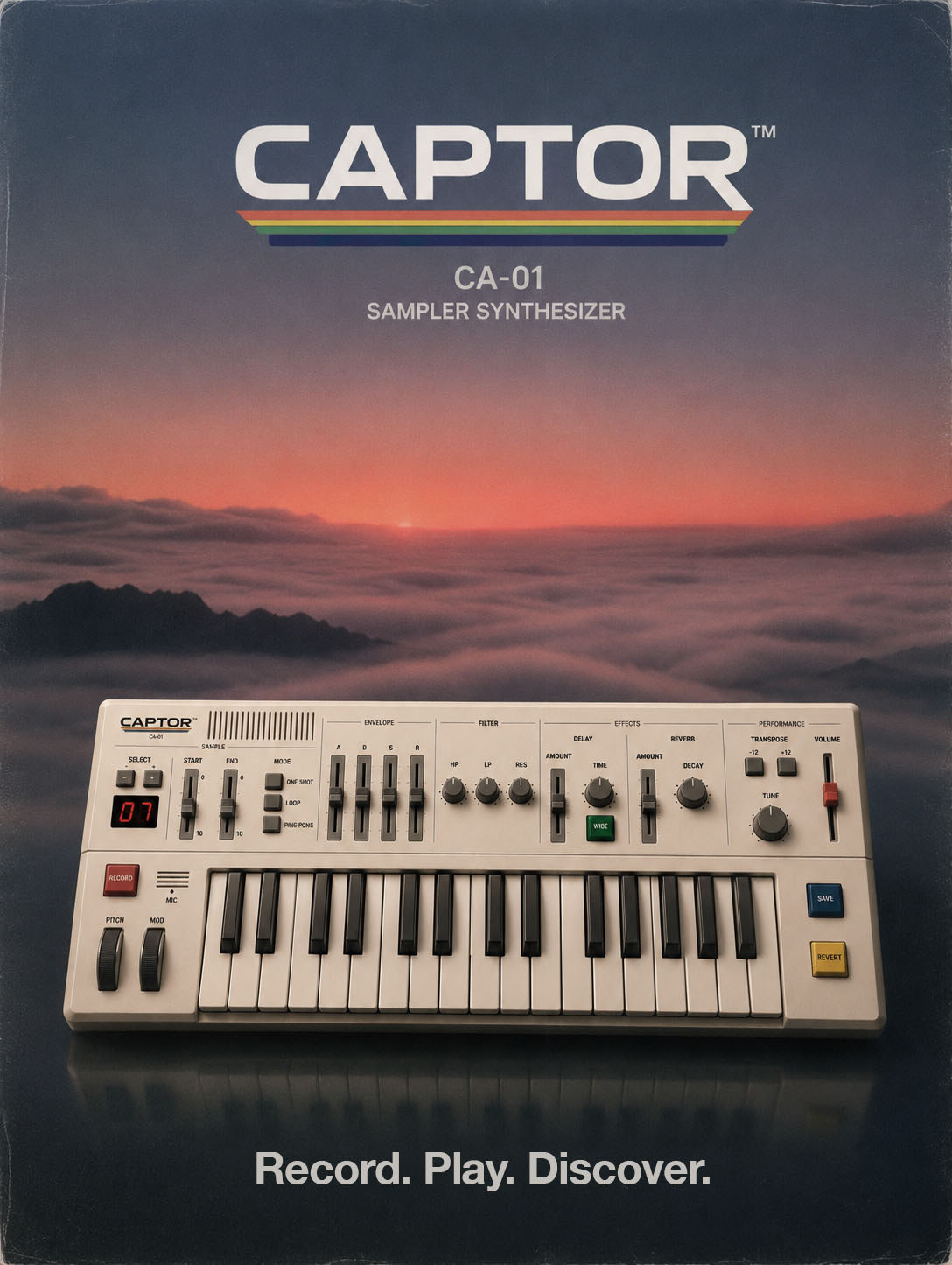
I have a few synths and a DAW but I wanted to find a simple sampling keyboard that captured that same feeling. I've always been aware of the Casio SK-1 and the Yamaha VSS-30 (I first heard about it because Sigur Rós mentioned it in a magazine somewhere. I think you can hear its weird looping and reversing tricks all over the We Bought a Zoo soundtrack. Nobody is going to recommend that to you in 2026, so you should probably go and listen to it.) and thought, surely something like that exists that isn't a bloody pocket operator or has two thousand buttons and menus.
Something immediate enough for a child to enjoy, but interesting enough for a musician who grew up with Spectrums, Amigas, Nintendos and old PC's to keep exploring or at least experiment with.
Turns out it doesn't really exist. (Yet!)
Turns out it doesn't really exist. (Yet!)
Many of today's instruments are incredibly powerful and inspiring. I love them and want them all.
CAPTOR came about because I was looking for something simpler: an instrument that could be understood in minutes and explored for years. At a minimum it should sound like an SPC700.
CAPTOR came about because I was looking for something simpler: an instrument that could be understood in minutes and explored for years. At a minimum it should sound like an SPC700.
Part toy, part sampler and then part old home computer, without undermining the core principle:
Record a sound.
Play it.
Shape it.
Discover what it becomes.
PHILOSOPHY
Modern technology often hides its workings. Sleek boxes with soft buttons that fit in bags.
CAPTOR does the opposite.
CAPTOR does the opposite.
A clunky beige box with four loud, clacky keyboard switch keys.
Every sound, a WAV file. Every instrument, a text file. Every setting can be read, edited, copied, shared or ignored completely. ("Right click > open with > notepad", finally making a comeback).
Every sound, a WAV file. Every instrument, a text file. Every setting can be read, edited, copied, shared or ignored completely. ("Right click > open with > notepad", finally making a comeback).
This approach was inspired by the home computers I grew up with.
Strange giant metal objects that your brother opened up and stuck circuits into.
Strange giant metal objects that your brother opened up and stuck circuits into.
CAPTOR is the first in a group of devices built inside these sorts of limitations.
No screen. No menus. No companion app. No endless list of features. Less cost (hopefully!).
These are not omissions but design decisions.
Explore, play, spend time with an idea. Commit and wait. See what happens!
The front panel contains everything needed to enjoy the instrument. Most users should never need to open a text file. For those who do, another layer exists beneath the surface.
The front panel contains everything needed to enjoy the instrument. Most users should never need to open a text file. For those who do, another layer exists beneath the surface.
Open a file, change a number then save it.
"Run" it and see what happens.
"Run" it and see what happens.
No extra features are hidden behind subscriptions, accounts, proprietary formats or software.
The goal is not maximum power. The goal is maximising 'what ifs'.
The goal is not maximum power. The goal is maximising 'what ifs'.
A child should be able to record a sound and play it immediately.
Someone more experienced should still be discovering things years later.
Someone more experienced should still be discovering things years later.
The front panel is the instrument.
Everything else is an invitation.
Everything else is an invitation.